Argentina's mining sector is once again occupying a prominent place in the country's economic debate.
By Panorama Minero
That is the main conclusion of the report “Argentina's International Positioning: This Time Could Be Different”, recently published by the Argentine Council for International Relations (CARI), one of the country's leading institutions in geopolitical, economic and foreign policy analysis.
The report was prepared by economist Rodolfo Carciofi, a consulting member of CARI and former director of the Institute for the Integration of Latin America and the Caribbean (INTAL) at the Inter-American Development Bank (IDB). Drawing on extensive experience at international organizations such as the IDB and ECLAC, as well as previous positions within Argentina’s Ministry of Economy, Carciofi examines how current changes in the global economy could create a new opportunity for the country.
The publication was edited by María Fernanda Rey, designed by Mario Modugno, and recently presented at the Mosconi Institute.
The report's central argument is that Argentina may be facing a different scenario from previous experiences of economic opening. According to the author, two processes that rarely coincided over recent decades are now converging: a transformation of the international environment and a set of domestic reforms aimed at promoting investment, stabilizing the macroeconomy and expanding export capacity. Within that framework, mining appears as one of the sectors with the strongest growth prospects.
Critical Minerals and Secure Supply Chains
The report highlights that during 2025 the effects of measures adopted by the national government to promote export-oriented sectors, including mining, began to materialize.
According to the report, “in mining, there were clear signs of the government's interest in attracting investment to the sector,” while international geopolitical changes helped reposition Argentina within the global map of critical minerals.
Carciofi argues that growing competition among major economies to secure access to strategic raw materials has created an opportunity for countries with abundant natural resources.
In that regard, the report states that “geopolitical disruptions have also worked in Argentina’s favor by placing the country on the map of critical minerals and secure supply chains.”
This observation gains relevance at a time when the energy transition, transportation electrification and the expansion of new technologies are driving demand for copper, lithium and other minerals considered essential to industrial supply chains.
Copper Returns to the Spotlight
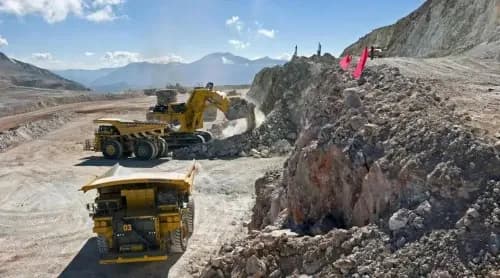
One of the report's key points is the attention being drawn to Argentina's copper potential.
The document notes that the proposed amendment to the National Glacier Law, currently under discussion, could become an additional factor attracting investment.