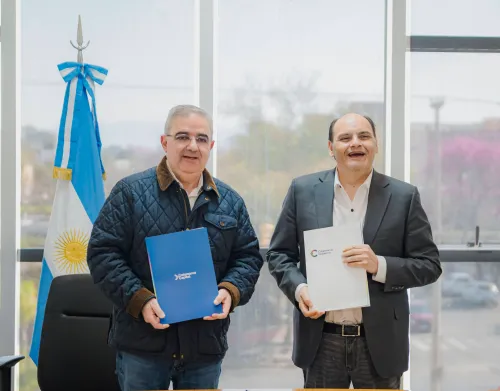
Governor Gustavo Sáenz met with authorities from the Inter-American Development Bank (IDB) to advance the Logistics Infrastructure Program for Regional Integration in Salta, which foresees an investment of up to US$100 million aimed at paving the final pending sections of National Route 51 up to the Sico Pass.
By Panorama Minero
The announcement was made following a meeting led by Governor Gustavo Sáenz with the IDB representative in Argentina, Viviana Alva Hart, and the organization’s Southern Cone Manager, Morgan Doyle.
The main project within the Logistics Infrastructure Program for Regional Integration in Salta includes the paving of two key sections of National Route 51: Campo Amarillo–Salar del Rincón, covering 53 kilometers, and Salar del Rincón–Paso Internacional de Sico, covering 38 kilometers. Currently, both sectors feature improved but unpaved roads, which limits logistical circulation, especially during adverse weather conditions.
A Strategic Route for Mining
National Route 51 constitutes one of the most important logistical corridors in northern Argentina for mining activity, particularly for the province of Salta. The route connects the city of Salta with the Salta Puna region and the Sico Pass on the Chilean border, crossing areas influenced by lithium projects as well as metalliferous mining operations and exploration activities.
The project aims to strengthen mining logistics, improve connectivity with Pacific ports, and position northern Argentina as a strategic artery within the Capricorn Bioceanic Corridor.
Regional Integration
The Capricorn Bioceanic Corridor is a South American integration initiative seeking to connect west-central Brazil, northern Argentina, Paraguay, and northern Chilean Pacific ports, creating a logistical alternative to traditional Atlantic trade routes.
In the case of Salta, National Route 51 and the Sico Pass represent a key axis for access to the Chilean ports of Antofagasta and Mejillones, which are used by mining industries to export products to Asian markets.
The corridor forms part of the Initiative for the Integration of Regional Infrastructure in South America (IIRSA). During the meeting, Morgan Doyle highlighted that the project aligns with “Conexión Sur,” a regional IDB initiative focused on strengthening South American physical and logistical integration.
Logistics Infrastructure and Production Control
In addition to paving works, the program includes the creation of a cargo control and mining inspection center aimed at optimizing transport supervision and improving the collection of logistical and production data throughout the region.
The plan also contemplates the incorporation of connectivity systems in remote areas of the Puna, an aspect considered essential for operational safety and transportation traceability.
Liliana Corona, Secretary of Financing and Financial Planning for the Province, explained that the comprehensive strategy behind the Bioceanic Corridor involves complementary financing from various multilateral organizations, including the IDB, the World Bank, and Fonplata.
Provincial authorities emphasized that, through this project, Salta seeks to consolidate itself as one of the main logistical and mining hubs in northern Argentina, strengthening its position within the global critical minerals supply chain and improving its commercial connection with the Pacific.