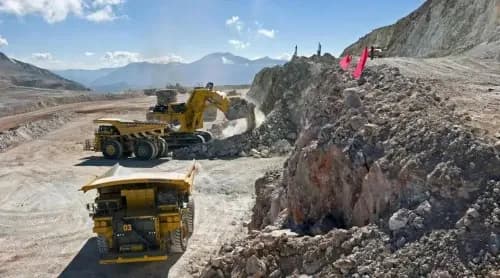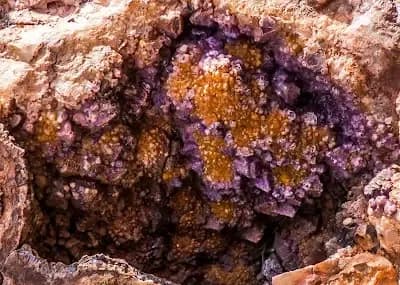
The town of Sierra Grande, in Río Negro province, hosts significant fluorite resources, a mineral traditionally associated with the chemical and metallurgical industries that has gained increasing prominence in international markets due to its applications in electromobility.
By Panorama Minero
Fluorite is a key input in the production of polyvinylidene fluoride (PVDF), a high-performance polymer used as a binder in battery cells for electric vehicles.
Amid growing global demand, a number of international investors have turned their attention to the southeastern Río Negro region. Historically linked to iron mining, as home to what was once Latin America's largest underground iron mine, Sierra Grande is also believed to host substantial fluorite resources.
One of the most advanced initiatives is being developed by JG Fluorita, a Chinese-owned company conducting exploration activities in the Delta 21 area. According to the company, the project could involve investments of approximately US$1.5 billion over the next five years.
Joaquín Aberastain Oro, Río Negro's Secretary of Mining, noted that Delta 21 is not the only fluorite-related initiative under evaluation. However, he acknowledged that all current projects remain at an early stage of development.
“Basically, what is being sought today is to determine the real geological and economic potential of areas where production previously existed,” he explained.
In that regard, the official emphasized that the possibility of producing fluorite in the province is not new. “The mineral has always been available for exploration and production. What has changed are the profitability conditions offered by today's global market,” he said.
Other Opportunities for Río Negro
Beyond fluorite, Río Negro continues to strengthen a diversified mining portfolio.
The province is nearing the restart of gold and silver production at Calcatreu, the Patagonia Gold-operated project located south of Ingeniero Jacobacci.
At the same time, uranium exploration continues to advance at the Ivana deposit within the Amarillo Grande project, developed through a joint venture between Blue Sky Uranium and Corporación América.
According to Aberastain, the project must still complete several technical and economic evaluation stages before moving toward potential production.
“Once that happens, we will be in a position to contribute to the uranium supply of Argentina’s three nuclear power plants, avoiding costly imports and strengthening the country's nuclear sovereignty,” he stated.
Argentina's Fluorite Potential
In addition to Río Negro, Argentina hosts fluorite resources in provinces including Córdoba, Chubut, La Rioja and Santiago del Estero.
Among the main producers is Fluorita Córdoba, operator of the Cerros Negros mine, located west of Río de los Sauces. Another relevant player is Grupo Hanaq, which, through Delta Fluorita, develops activities in the North Patagonian Massif between Río Negro and Chubut.
Secitam Córdoba is advancing the Gumersindo and Flamenco projects in Chubut, while Minetti, through Michelotti Servicios Mineros, is working on a fluorite deposit located in the mountains of La Rioja province, within the Vinchina department.
At the exploration level, the Argentine Geological and Mining Survey (SEGEMAR) has also identified fluorite potential in Santiago del Estero, along with other non-metallic minerals such as aragonite, calcite, chalcedony, quartz, steatite and feldspar.
An Opportunity Linked to the Energy Transition
Although fluorite remains widely used in industries such as steelmaking, chemicals, glass manufacturing, refrigerant gases and abrasives, its growing demand from electromobility supply chains has become one of the sector's main growth drivers.
In Argentina, the fluorite market has experienced significant fluctuations over time. Demand from the domestic steel industry was particularly important until the early 1990s, while fluorite used for hydrofluoric acid production also played a significant role until the economic crisis of 2001, which led to the closure of local plants and increased reliance on imports.
Today, China remains the world's leading fluorite producer. However, rising global demand is creating opportunities for projects located outside the country.
In that context, the development of Argentina's fluorite resources will depend not only on increased exploration activity, but also on producers' ability to meet the technical standards required by highly specialized industries such as electronics and automotive manufacturing.