Mining and artificial intelligence compete for capital and resources, but they can also reinforce each other. An analysis by Eng. Eduardo Barrera, Advisor to the European Union’s Critical Raw Materials (CRM) Facility.
By Panorama Minero
In almost every global conversation about artificial intelligence, we hear the same concepts: algorithms, models, chips, silicon and computing. We talk about parameters, scaling laws, GPUs, latency, hallucinations and benchmarks. But there is something essential that is almost never mentioned: AI is not just software. AI is matter.
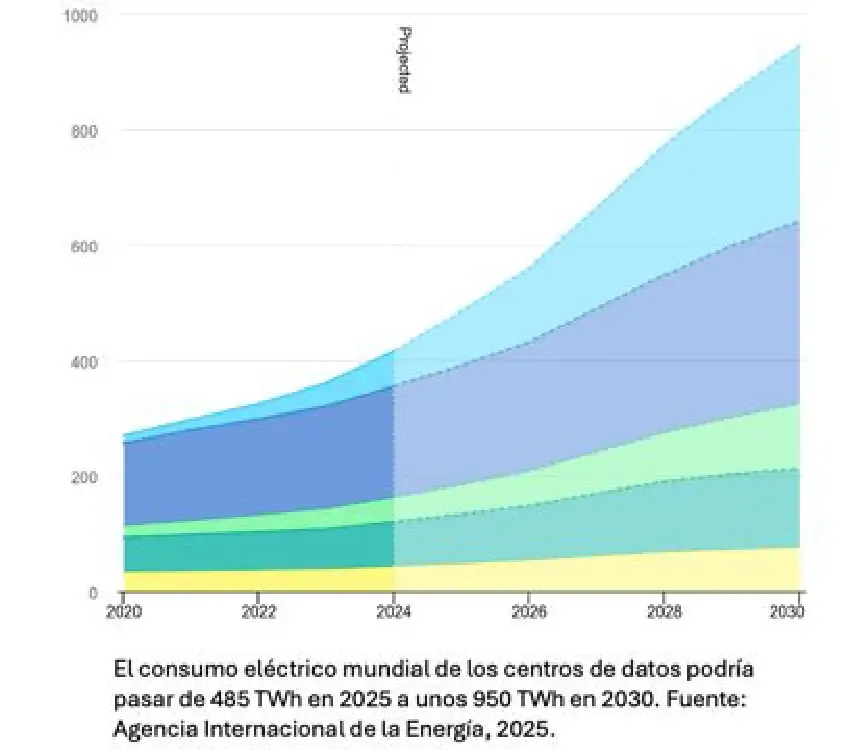
Behind every model we train, every chip we manufacture and every increasingly large data center that is built, there is an enormous physical infrastructure: copper extracted from mines, lithium pumped from salt flats, rare earths refined through complex industrial chains, gallium produced through highly concentrated supply networks, millions of liters of water and vast amounts of energy.
AI does not float in the cloud. AI has weight. AI occupies space. AI consumes critical minerals. At its core, it is a material system that depends on territories, ecosystems and supply chains that are already under considerable pressure.
This creates the central paradox of our time: the most digital revolution in history is also one of the most physical. The data economy rests on the mineral economy. The future of computing depends on the future of extraction. Artificial intelligence literally needs more mineral intelligence.
That is the conversation missing from the global debate on AI, and it is the conversation we should open today in order to better prepare ourselves. Intelligence is anticipation.
1. The Material Foundation of AI: Critical Minerals, Energy, Water and Land
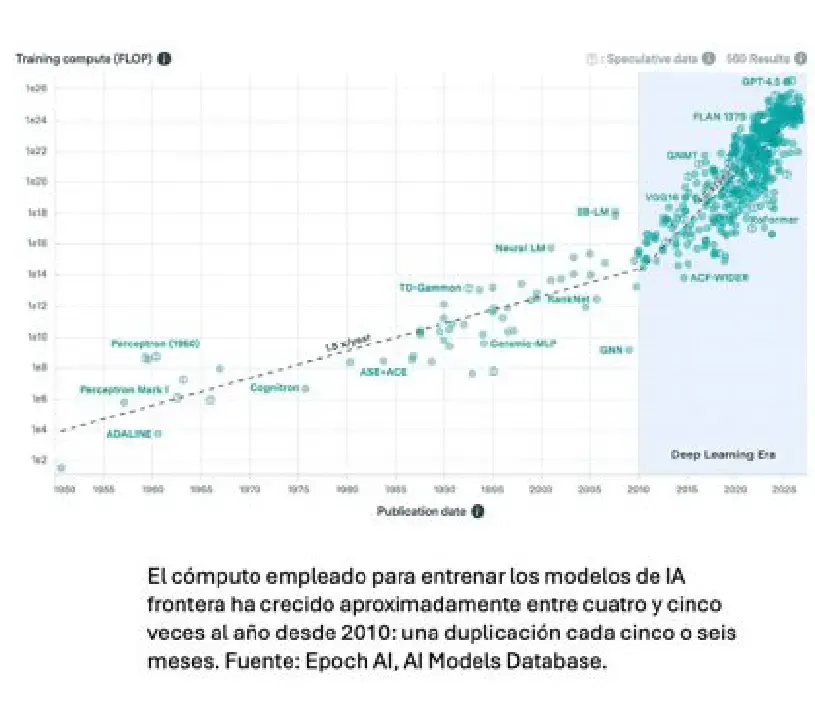
The computational demand of frontier models is growing exponentially: training compute has doubled every five or six months since 2010. This is a pace far greater than what Moore’s Law once represented for computing. Each doubling requires more copper, lithium, rare earths and gallium.
Copper. AI data centers require between 27 and 33 tonnes of copper per megawatt, and up to 47 tonnes per megawatt in intensive training clusters. When transmission lines and substations are included, total demand reaches between 100 and 150 tonnes per megawatt.
Gallium. High-performance chips increasingly depend on gallium nitride. Demand from data centers could exceed 10% of global supply by 2030.
Rare earths. Cooling systems use neodymium-iron-boron magnets. This demand is expected to grow by around 7.5% annually through 2040.
Lithium. Energy storage associated with AI could reach approximately 300 gigawatt-hours by 2030.
Water and land. AI data centers consumed around one trillion liters of water in 2025—almost 1 cubic kilometer. This is roughly 10 times the amount consumed by Escondida; the world’s largest copper mine.
Training GPT-3 in Microsoft data centers in the United States consumed approximately 700,000 liters of water; larger models, such as GPT-4, consume even more. Today, “hyperscale campuses”—the largest data centers—occupy anywhere from dozens to thousands of hectares: Google’s facility in Maryland covers around 364 hectares, while Meta’s facility in Louisiana already exceeds 1,480 hectares. In terms of built surface area, the Stargate campus in Texas approaches 372,000 square meters.
2. A Relationship That Can Be Symbiotic
AI and mining also complement each other. The same AI that creates such significant demand for mining can also help strengthen the industry by enabling faster and more efficient exploration and greater productivity and operational safety. One example is the combination of autonomy with digital twins—as is already being implemented at Escondida in Chile, operated by BHP, and Quellaveco in Peru, operated by Anglo American.
In terms of AI-assisted exploration, the most compelling example is Mingomba in Zambia: mining company KoBold moved from discovery to development—the period between discovering a copper deposit and bringing it into production—in just five years, compared with a global average of nearly 18 years. AI shortened the cycle by more than a decade.
This is not an isolated case. In general, the most advanced predictive models can reduce the exploration area required by as much as 80%, without sacrificing—and sometimes even improving—the discovery rate. They process decades of historical data in weeks, compared with months using traditional analysis, and can reduce exploration capital by between 40% and 80% through optimized drilling.
If mining is, in part, the material foundation of AI, AI can in turn become the lever that accelerates the supply of the very minerals it needs, as well as those required by the energy transition. That is the symbiotic relationship: each need the other and each can help the other grow.
However, the relationship can also become competitive from a financial standpoint because both activities are highly capital-intensive and draw on the same sovereign wealth funds, infrastructure vehicles and debt markets. AI requires US$2–5 billion for each major data center, with training cycles renewed every few years, while mining requires US$2–10 billion to develop long-life physical assets with complex energy, water and logistics infrastructure.
Frontier AI and large-scale mining currently compete for significant volumes of capital because both require multibillion-dollar investments, although their structures are very different. AI requires US$2–5 billion for hyperscale data centers and training cycles that are renewed every few years, while mining requires US$2–10 billion to develop long-life physical assets with complex energy, water and logistics infrastructure.
This similarity in investment scale means that both industries draw on the same sovereign wealth funds, infrastructure vehicles and debt markets, although AI attracts capital seeking faster returns while mining attracts long-term strategic capital. Even so, AI depends on critical minerals such as copper, lithium, nickel and rare earths. Therefore, although the two industries compete for financing, they ultimately remain complementary sectors within the global economy.
3. Falling Costs of Open Models: The Opportunity and Risk of a Two-Speed Mining Industry
Another factor is changing the landscape: open-source AI models are, on average, only around four months behind closed frontier models—and are vastly cheaper. Just a year ago, that gap was nearly 12 months, and it continues to narrow.
This represents an enormous opportunity for junior mining companies. Companies that could never afford the complete proprietary stack of a major technology provider can now access AI-assisted exploration, blasting optimization, mine planning, predictive maintenance and autonomous systems at a fraction of what they would have cost only a few years ago. Potentially, this represents the greatest productivity leap these mining companies can leverage to narrow the gap with the majors.
But this reduction in costs does not come without challenges. Artisanal and small-scale mining—which employs between 40 million and 45 million people worldwide—risks falling even further behind if it does not gain access to these same tools. Adoption of autonomous mining is currently concentrated in large projects, while the rest of the industry continues to have limited access to technology and digital infrastructure, as well as few training opportunities.
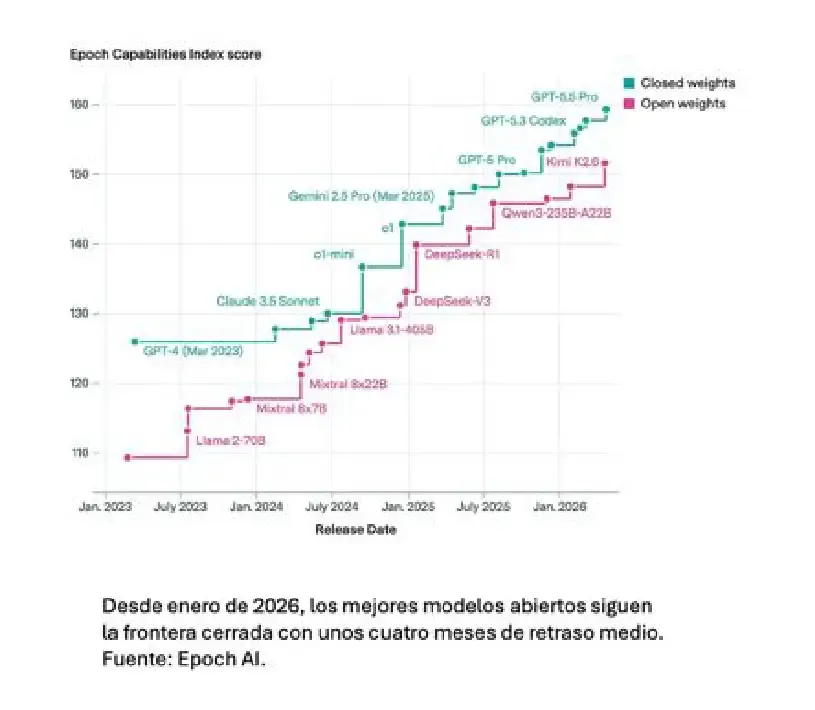
Without deliberate intervention, AI will not help close the mining sector’s productivity gap; instead, it is likely to deepen it.
Conclusion: The Missing Public Policy
AI and mining are intertwined within the same material and technological cycle. AI needs minerals, and mining needs AI to explore, operate and compete. And both need water, energy and land. This relationship can be symbiotic—but it will not become so by default.
An explicit public policy is required, with at least three tasks: assessing how both industries affect the same territory—whether through competition or positive synergies based on enabling infrastructure when properly coordinated—monitoring how AI adoption is distributed across the sector in order to help close the gap affecting junior mining companies and mining SMEs, and facilitating the technological leap that more affordable open models already make possible before the window of opportunity closes.
Without such policies, AI and mining could end up competing for the same territory, slowing the development of a symbiotic relationship between the two. It could even become, in practice, a two-speed race, in which the most advanced are already moving forward with a flashlight while the rest are trying to advance in the dark.
The question is not whether AI will transform mining, because it is already doing so. The question, rather, is how to help ensure that this relationship is synergistic and that its symbiotic transformation reaches everyone, not just a few.