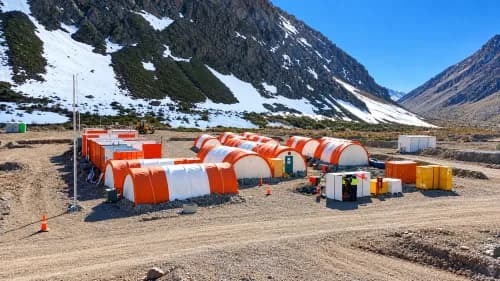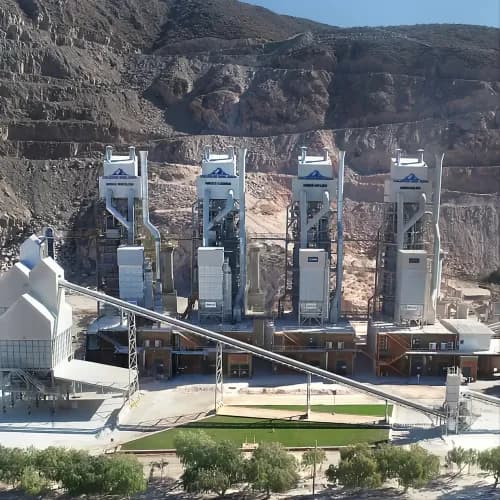
The Government of San Juan, through the Provincial Institute of Mining Explorations and Exploitations (IPEEM), launched a public tender to award nine mining areas located in the departments of Iglesia and Calingasta, with potential for the exploration of copper, gold, and silver. The head of the agency, Natalia Marchese, explained that the process will be carried out under the risk contract modality, where companies will assume the investment in exploration while the province will maintain ownership of the mining rights.
The tender documents will be available from March 20 to June 22, and the process has already attracted interest from several companies. In addition, IPEEM is working to expand its portfolio with projects linked to lithium and rare earth elements.
By Panorama Minero
San Juan is an unavoidable reference point on the global mining map, attracting the attention of international investors thanks to its vast geological wealth and multiple mineralization options. In this context, the provincial government, through the Provincial Institute of Mining Explorations and Exploitations (IPEEM), has initiated a public tender process that offers nine areas located in the mountain range. This initiative responds to a state policy that seeks to position San Juan as the number one destination worldwide for the development of mining projects, promoting both the exploration and exploitation of its resources.
Under the presidency of Natalia Marchese, the institute designed this call for tender with areas located in Iglesia and Calingasta. In the first department, the zones selected for this process include Bordo Atravesado, Josefina, Patri, Arroyo de los Amarillos, and Marianela. Meanwhile, in the second department the projects León, Rincones de Araya, Margaritas, and the Calderón–Calderoncito area will be tendered. These areas present significant potential for the discovery of metallic minerals.
The contracting model chosen for these areas is the risk contract, an administrative scheme that allows private companies to assume the entire initial investment in the exploration stages. If the results of these initial works prove successful, the companies have the option to move forward to the exploitation stage of the deposits. This mechanism ensures that the financial risk is assumed by the interested capital, while the State maintains ownership of the mining rights and guarantees the continuity of economic activity in the province.
The schedule established by IPEEM indicates that the tender documents and conditions will be available for purchase starting March 20 until June 22 of the current year. The evaluation process will be divided into stages, beginning with the opening of a first envelope on June 23, which will contain all the legal, financial, and economic information of the bidding companies. Subsequently, a second envelope will be opened containing the technical and economic proposal, where the companies will detail their investment programs and the type of work they plan to carry out in the mountain range.
According to Marchese, the interest generated so far is significant, with numerous inquiries from companies seeking to understand the geological potential of these areas, some of which have previous exploration background while others represent new challenges for the sector. Among those with exploration background are Rincones de Araya and Calderón–Calderoncito.
In addition, the current management of IPEEM is working on diversifying its project portfolio. A central objective for this year is the inclusion of critical minerals, such as lithium and rare earth elements, in future tender calls. The institute is currently in a phase of opening portfolios and conducting prospection to define properties that contain these strategic elements. In the case of lithium, the goal is to explore opportunities to prospect and explore in the salt flats present in San Juan. It is also worth noting that its presence is being studied in rock formations known as pegmatites. Currently, there are prospection and sampling works in border areas with other provinces, and in local projects to determine whether these resources have viable potential. It should be noted that San Juan has the Los Sapitos lithium project in the department of Iglesia, bordering La Rioja. Some prospections were also carried out in the Mascasín salt flat.
Regarding rare earth elements, their search represents a greater challenge due to the difficulty of finding them in nature in economically viable concentrations. Nevertheless, the institute has indicated that San Juan possesses rock formations with geological characteristics suitable for hosting these minerals. The official intention is to place these areas in the hands of investors who wish to prospect them and define the real potential of these elements, which are essential for modern technologies.
Finally, Marchese emphasized that regardless of the origin of the capital — whether national, as in the case of Minera Aguilar or foreign — the activity must be carried out in compliance with work programs, environmental responsibility, and with a vision of mutual benefit between the companies and the province.