Glencore Argentina’s CEO outlined the company’s copper roadmap in the country: reopening Bajo la Alumbrera to place Argentine copper on the market in 2028 and developing El Pachón through successive stages. He also identified the four challenges mining must respond to for society: employment, water, infrastructure, and local development.
By Panorama Minero
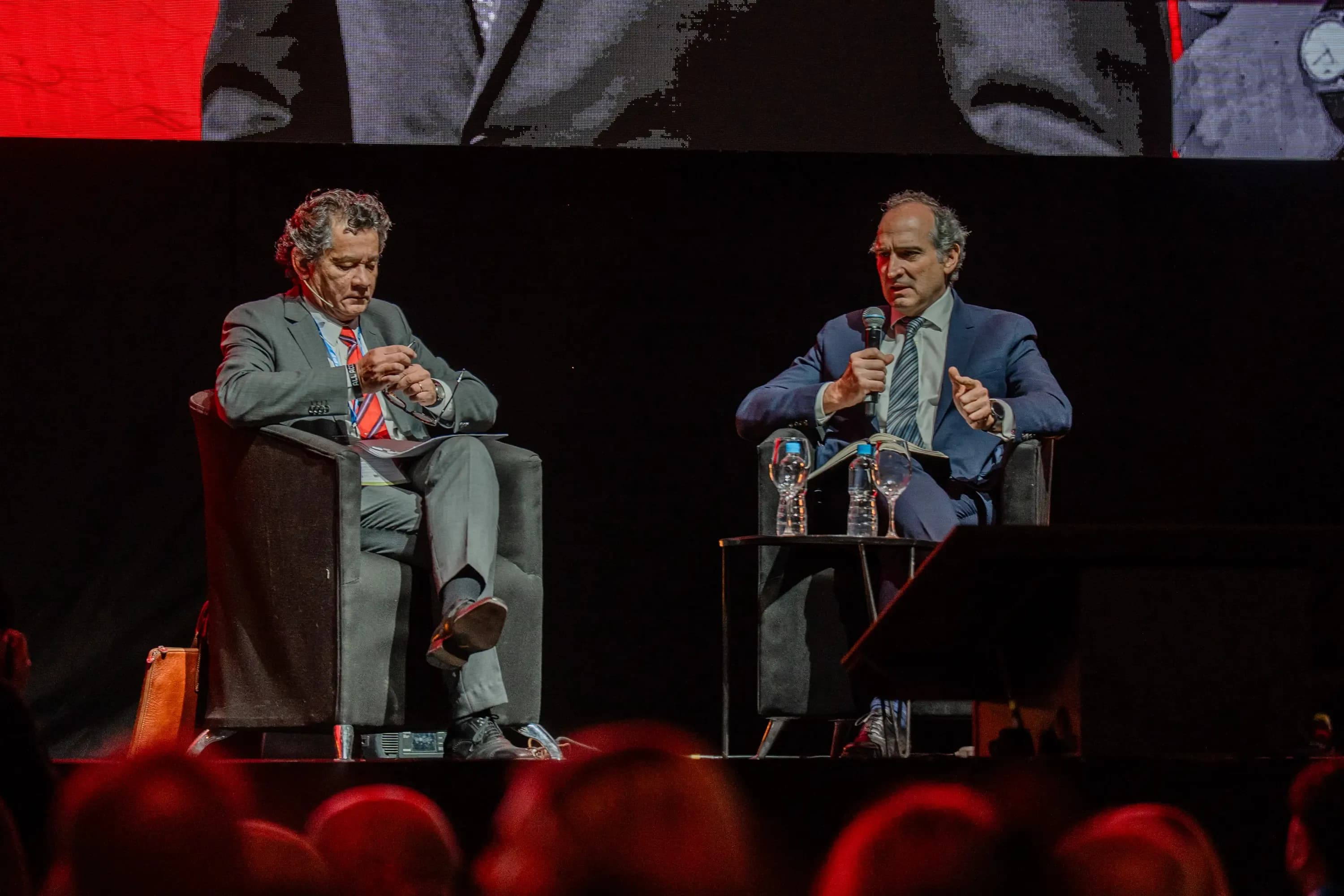
Glencore Argentina CEO Martín Pérez de Solay presented the pillars of the company’s strategy in the copper sector: the reopening of Bajo la Alumbrera in Catamarca as a bridge toward El Pachón in San Juan, a staged growth vision, and four challenges that mining must address for society: employment, water, infrastructure, and local development. As a long-term goal, he framed the scale of the challenge with a striking benchmark: achieving in ten years 40% of what Chile accomplished in 100. He made these remarks during the Argentina Cobre Sessions at San Juan Minera 2026, organized by Panorama Minero.
In a conversation with Ernesto Cussianovich, Associate Director of Energy, Natural Resources and Environment at Poliarquía, the executive outlined the company’s roadmap and his perspective on the current state of mining in Argentina. The first concrete announcement was the objective of reopening Bajo la Alumbrera.
“We have just announced the goal of restarting Bajo la Alumbrera, which could place Argentine copper on the market in 2028,” stated Pérez de Solay. The reopening, he explained, would serve as a productive bridge for four or five years, taking advantage of the twelve known mineralization stages, while leveraging the existing infrastructure to later advance toward Agua Rica.
Regarding El Pachón, Pérez de Solay was emphatic: “It is a project that will be developed to its maximum capacity.” With more than 6 million tonnes of resources and sustained grades throughout the deposit, he described a project whose first phase—processing 185,000 tonnes of ore per day—already projects more than 70 years of production. “No one plans a mine for 70 years,” he said, emphasizing that El Pachón has successive stages of development ahead. “It is always viable to place production. That is the beauty of this project.”
Gradual development and orderly execution were recurring themes throughout his speech. “A year ago, we made the decision to go all in and build an orderly growth program,” he stated, highlighting that Glencore is working in close coordination with both provincial and national governments.
The Four Issues Mining Must Address
Pérez de Solay structured his analysis around four demands that, according to him, San Juan society—and, more broadly, the communities where mining operates—expects the sector to address.
Employment - “There is significant concern in Argentina regarding employment, supported by many years without investment. Mining is projected as a sector capable of generating jobs,” he said.
Water - He described water as “critical and fundamental.” He acknowledged that San Juan’s water issue exists with or without mining, but argued that the industry can contribute to improving efficiency in water use and to developing water compensation strategies between regions. “We need to start thinking intelligently,” he said.
Local Development - The third axis focuses on ensuring that the growth generated remains within the province where production takes place. In this regard, he noted the proliferation of supplier chambers in San Juan—around 28, compared to three in Peru and two in Chile—as an indicator of strong local expectations, but also of fragmentation.
Infrastructure - Here Pérez de Solay was direct: mining companies should not be responsible for financing infrastructure. “Infrastructure returns are lower than mining returns. Using mining-risk capital for infrastructure is a misuse of capital,” he argued. The solution, he suggested, lies in mining companies putting demand and usage contracts on the table so that infrastructure specialists can build at competitive rates. “We specialize in what we know how to do.”
To conclude, Pérez de Solay referred to a figure that illustrates the scale of the challenge: “In 10 years, we want to achieve 40% of what Chile accomplished in 100.” The statement summarizes both the sector’s ambition and the complexity of the path ahead. “The scale of the numbers ahead of us scares me,” he admitted, though from an optimistic standpoint. “Everything we need to do to make it happen is happening. This time is different.”