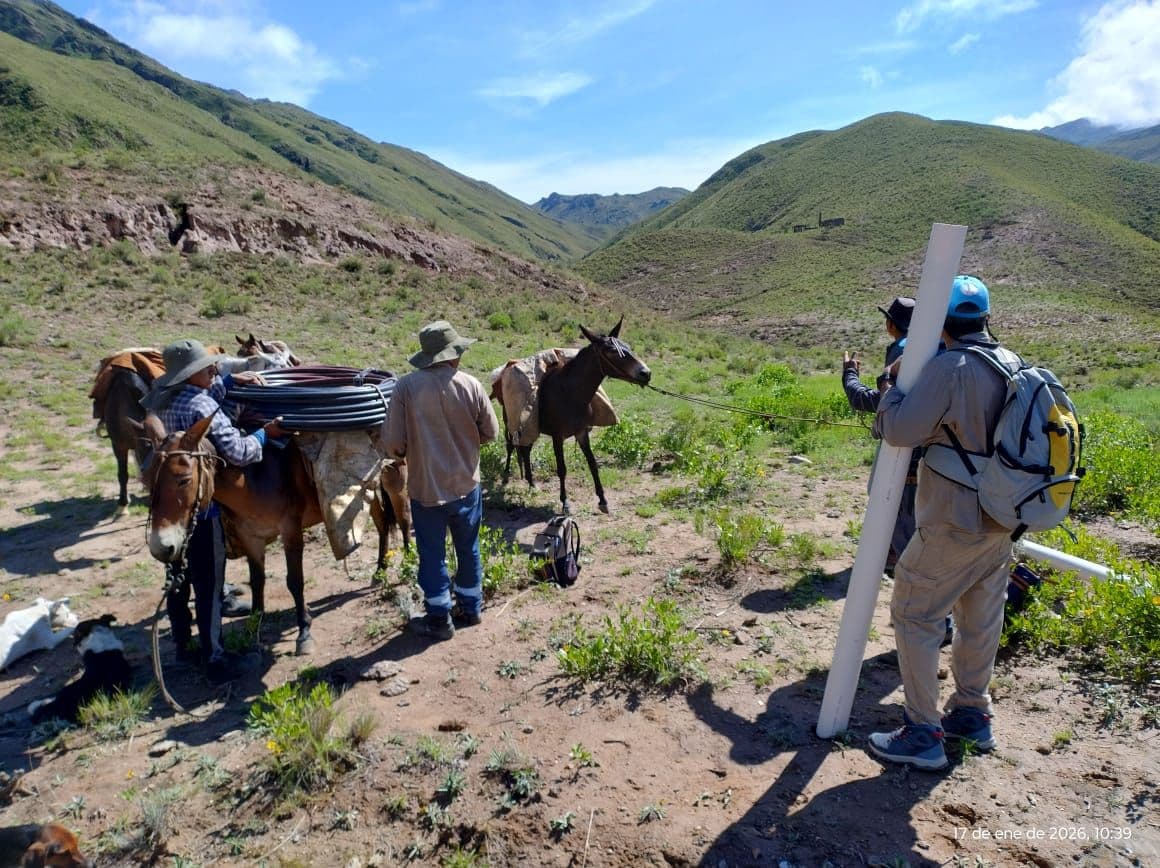
Following a field assessment, MARA, the foundation and communities from eight mining outposts carried out small-scale, high-impact works to improve water quality for household use and agrolivestock activities.
By Panorama Minero
Through a joint initiative between the Eco Conciencia Foundation and Minera Agua Rica Alumbrera (MARA), eight water infrastructure improvement projects were implemented in outpost communities located between Andalgalá and Santa María, in Argentina’s Catamarca province. These are rural settlements where families engage in small-scale agrolivestock activities and, in many cases, are also linked to the mining industry.
Benjamín Borghesio, a field engineer with the Eco Conciencia Foundation, highlighted the scope of the work and noted that the organization seeks to “achieve peace through community development.” He also underscored the key support provided by MARA, which financed the projects, while all labor was carried out exclusively by members of the beneficiary communities.
The works were completed in the outposts of Aguas Amarillas, Santa Bárbara, El Portezuelo, El Lavadero and Minas Capillitas in the Andalgalá department, as well as El Ingenio, Loma Redonda and Buey Muerto in the Santa María department.
“We have been working in this area for four years, between Santa María and Andalgalá, along Provincial Route 47, which leads to Minas Capillitas. On this occasion, we conducted a socioeconomic and productive assessment to understand what local families do for a living and how we could support them. From that work, needs emerged related to road improvements, access to electricity, access to water, agricultural and livestock training, and even gastronomy training. Many areas for action became evident,” Borghesio told Panorama Minero.
According to the engineer, the assessment revealed that each outpost had precarious water intake infrastructure, whether from snowmelt, springs or wetlands. “What we proposed was to improve water supply through the construction of small-scale water works, using simple, readily available materials. The goal was to ensure safe access to filtered, good-quality water delivered directly to homes. In some cases, families had to carry water in buckets from nearby rivers, while in others the existing infrastructure was extremely fragile,” he explained.
Where some infrastructure already existed, the works focused on reinforcing and upgrading it, protecting water intakes from floods, preventing pipe blockages and improving solid filtration, thereby reducing the entry of plant debris into the system. “The idea was to leave well-built, long-lasting works that secure household water supply and, if flow allows, can also be used for irrigating gardens or watering livestock. These are projects with multiple benefits,” Borghesio added.
The Eco Conciencia Foundation designed the project, defined the technical solutions and prepared the budgets, while MARA was responsible for procuring the materials. Execution was carried out by the families themselves. “That was a condition set by the Foundation. We explain how to do the work, but it is essential that families participate. First, to ensure local ownership; second, so they gain skills for construction and maintenance; and third, so they truly make it their own. When people build something themselves, they take care of it and value it,” Borghesio explained.
The beneficiary families are primarily engaged in small-scale livestock farming, some also in greenhouse agriculture, and in most cases include members who work as mining employees while living in the outposts.
“We congratulate the company for supporting these initiatives. While these are small-scale water projects that do not involve large investments, their impact on families’ quality of life is highly significant, as they address a basic need such as access to water,” Borghesio concluded.