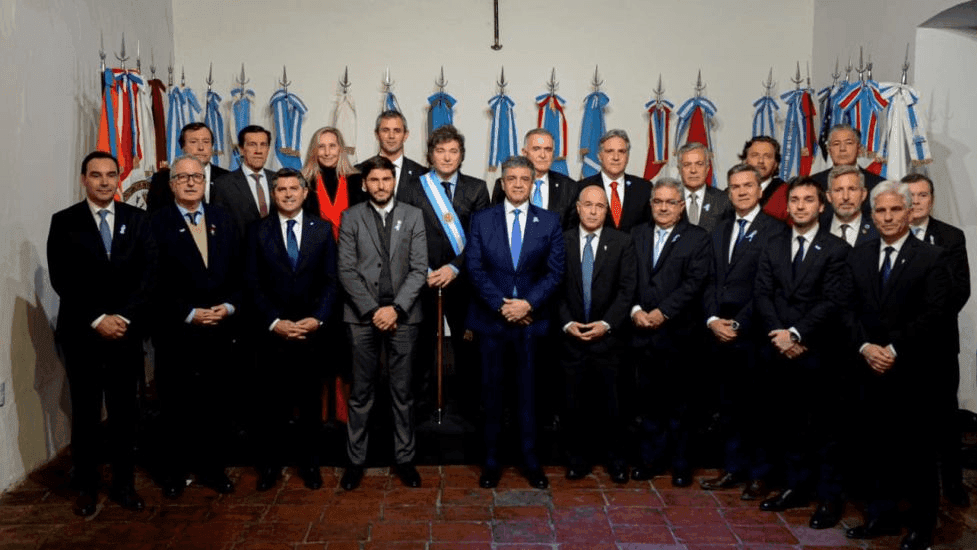
On Monday night, President Javier Milei signed the "Pacto de Mayo" in Tucumán, an agreement with both supporters and opponents of his government, aiming for a foundational shift. The pact, which included the participation of 18 provincial governors, bears a strong symbolic connection to the first National Constitution of 1853, written by Juan Bautista Alberdi. It assigns a clear responsibility to the mining sector in achieving Argentina's economic development goals.
By Panorama Minero
Among the attendees were key governors associated with the mining industry, including those from San Juan, Salta, Jujuy, and Catamarca. They supported a document that positioned the industry as one of the ten key points in the government's transformative initiative. "It is ridiculous that we share the Andes with Chile and do not produce copper," emphasized Javier Milei.
The "Pacto de Mayo" builds on other political initiatives by La Libertad Avanza following the approval of the "Ley Bases." Milei continues his mission to restructure Argentina's economic and political identity, particularly after signing the pact, which he hailed as an "act of greatness" and "love for the country," sealed in the context of the July 9th commemoration.
The document, with a foundational intent, includes ten clauses aimed at rebuilding Argentina's foundations and reintegrating the country onto a path of development and prosperity, according to government sources. These clauses range from the inviolability of private property to reducing public spending and tax reform, while granting a prominent role to the industrial sector and the development of natural resources.
The Ten Clauses of the Pacto de Mayo
1- The inviolability of private property
2- Non-negotiable fiscal balance
3- Reduction of public spending to historic levels, around 25% of GDP
4- Useful and modern initial, primary, and secondary education, with full literacy and no school dropouts
5- A tax reform that reduces the tax burden, simplifies the lives of Argentines, and promotes commerce
6- A revision of federal tax revenue sharing to end the current extortionate model affecting provinces
7- The commitment of Argentine provinces to advance in the exploitation of the country's natural resources
8- A modern labor reform that promotes formal employment
9- A pension reform that ensures system sustainability and respects contributors
10- Opening up to international trade, so Argentina can once again be a key player in the global market
Mining and Natural Resources
Milei emphasized the importance of exploiting natural resources, criticizing politicians who prioritize the demands of noisy minorities and environmental organizations funded by foreign millionaires. "God blessed our land with enormous wealth in natural resources. We have the possibility for Argentines to create wealth and live with dignity in every corner of the country. But politicians have listened more to noisy minorities and environmental organizations funded by foreign millionaires than to the needs of Argentines to prosper. We are here to change that demagoguery that condemns millions of Argentines to misery to please a few well-off individuals. Nature should serve humanity, not the other way around. The main environmental problem we have is extreme poverty. This can only be solved if we take advantage of our resources. We have reached the absurdity of sharing the Andes with Chile and not producing copper while they export over $50 billion a year of this mineral, more than twice what we export in soybeans," Milei stated.
Thus, the pact emerges as a central event for the present and future of Argentina's mining sector and industry, proposing a paradigm shift in the management of natural resources and the country's economic policy. If these changes are realized, and considering a global scenario that positions Argentina as a key player in meeting demands across multiple sectors, why not envision the country as a global mining reference?