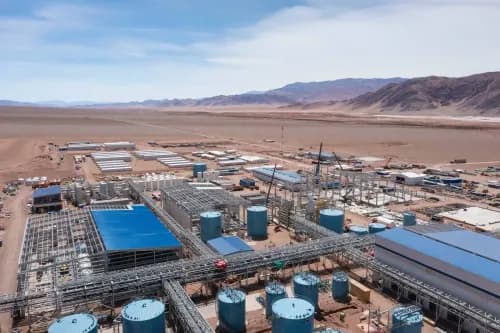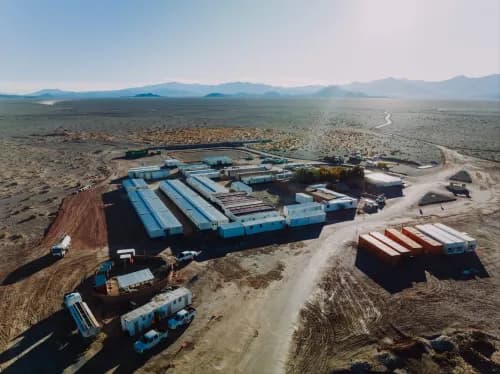
It signed an agreement with Distrocuyo to begin studies that will allow the construction of a new 220 kV transmission line and a transformer station in the high mountains of Mendoza. In this way, they aim to organize the project’s engineering and reduce uncertainty in an operation with high energy demand.
By Panorama Minero
One week after the promulgation of the provincial law that enabled PSJ Cobre Mendocino to advance to the feasibility stage, the project took a key technical step: it signed an agreement with Distrocuyo to secure the electricity supply required for its future high-mountain operation. This is a structural decision that goes beyond the project itself and has implications for the energy system of central Mendoza.
The agreement includes the construction of the San Jorge 220/33 kV Transformer Station and a new 220 kV High-Voltage Line that will connect the future mining operation to the Mendoza Norte Transformer Station. The work strengthens the reliability of the province’s central electrical ring and improves supply conditions for Uspallata and its surrounding area.
Electrical Infrastructure
In industrial-scale copper projects, electricity is not just another input: it is a technical enabler that affects timelines, costs, and process design. Early definition of the supply scheme helps reduce engineering uncertainty, organize project planning, and progress toward feasibility with greater predictability.
The solution agreed with Distrocuyo aims to ensure quality, stability, and sufficient capacity for an open-pit operation with a concentrator plant. The addition of a 220 kV line increases system robustness, reduces operational risks, and allows for the absorption of intensive, continuous demand characteristic of crushing, grinding, and flotation circuits.
From a systemic perspective, the new infrastructure is not limited to PSJ. Reinforcing the electricity transmission system improves supply reliability in central Mendoza, expands available capacity for future productive and commercial activities, and also enables the integration of renewable energy projects in the region.
Technically, this is a structural investment installed permanently in the territory. Access to more efficient energy with lower losses and greater stability also translates into operational and environmental advantages, aligned with the standards currently required by international copper mining.
The PSJ Project: Key technical features
PSJ Cobre Mendocino is located at Estancia Yalguaraz, about 35 kilometers from the town of Uspallata, over an area of 9,984 hectares. The deposit is a porphyry system with copper and gold sulfide and oxide mineralization, with an average copper grade of 0.47%.
The operation is designed as an open-pit mine, with a production sequence organized in five phases. The heart of the project will be a concentrator plant capable of processing 10 million tons of ore per year through a circuit that includes crushing, grinding, flotation, and filtering.
The final product will be a dry concentrate with approximately 25% copper content and traces of gold. Metallurgical tests showed recoveries of around 90% for copper, a key figure for the project’s economic and technical evaluation.
Energy and Process: A critical relationship
The design of PSJ’s production process implies significant energy demand, particularly during construction. Therefore, having a reliable electricity supply is crucial not only for future operations but also for defining technological alternatives, optimizing consumption, and projecting realistic operating costs.
The agreement with Distrocuyo includes engineering development, electrical studies, and regulatory procedures for integrating the new facilities into the Electricity Transmission System, in compliance with current regulations and the requirements of control agencies. Integration will be carried out in an orderly and safe manner, avoiding negative impacts on the existing system.
The electrical work takes place in a broader context. For decades, the high mountains of Mendoza have faced structural limitations in infrastructure and services. Within this framework, establishing a mining operation of this scale is a unique opportunity: no investment of this magnitude has been made in the area or the province in recent decades.
The development of energy infrastructure opens the door to structural improvements that go beyond the project, creating more competitive conditions for future productive activities, both mining and non-mining.
Local Coordination and Capacity Building
The agreement also includes a local development component. Distrocuyo expressed its willingness to promote the procurement of goods and services locally and participate in technical training initiatives related to energy and electrical infrastructure, in coordination with the training programs promoted by PSJ Cobre Mendocino.
These actions aim to strengthen local capacities, generate indirect employment, and leave lasting capabilities beyond the construction phase.
With the signing of this agreement, PSJ Cobre Mendocino begins to translate legislative approval into concrete technical decisions. Electrical infrastructure thus becomes one of the project’s first pillars, marking the start of a stage in which planning, engineering, and execution take center stage.