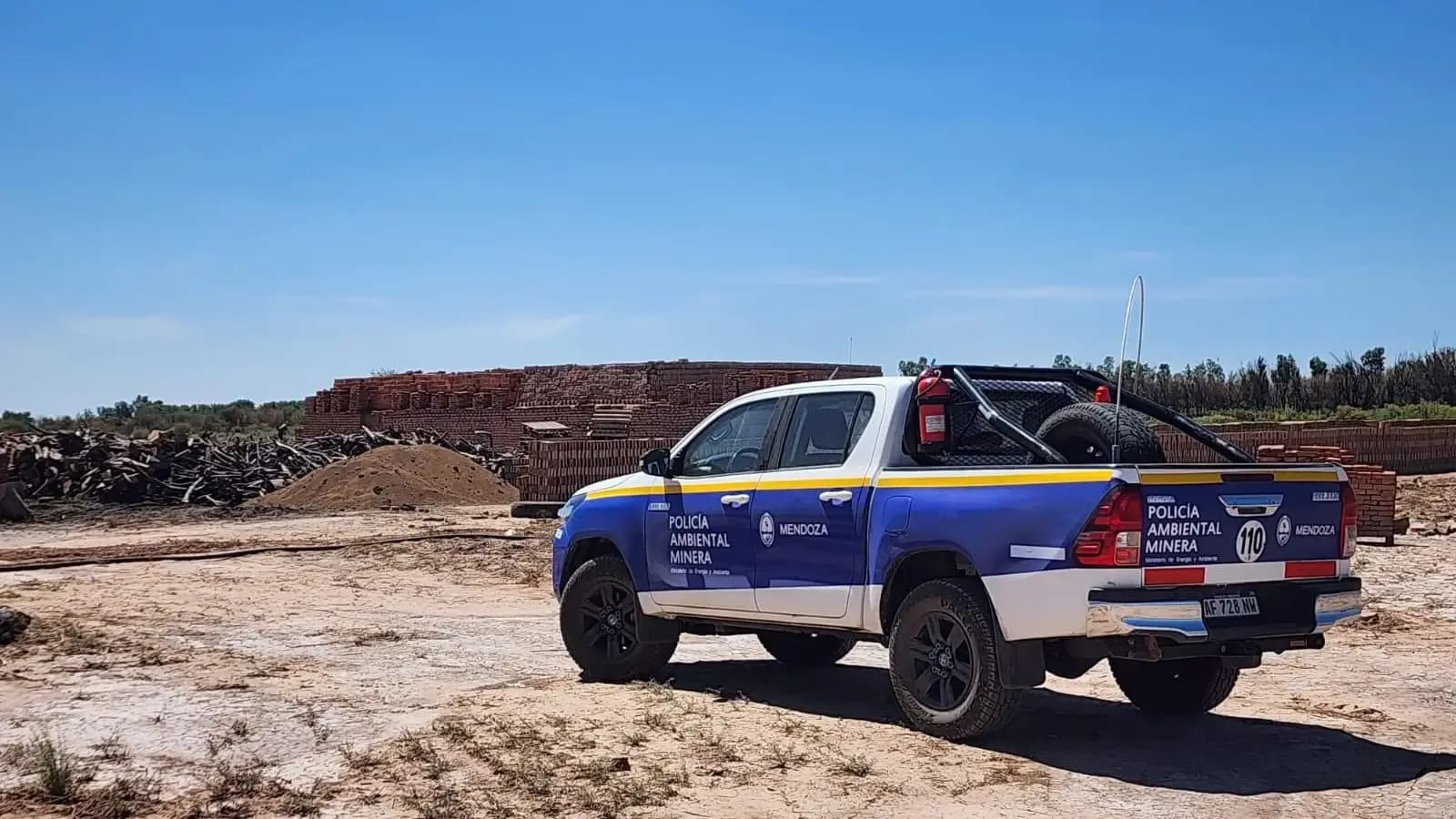
The Mining Environmental Authority carried out a territorial survey of brick-making activity in the district of Jocolí, department of Lavalle, with the aim of identifying active producers, assessing operating conditions, and advancing the environmental regularization of the sector.
The operation included the identification of active facilities, the registration of workers and families linked to production, and the assessment of the technical conditions under which the clay used for brick manufacturing is extracted and processed.
By Panorama Minero
The intervention takes place in a context of full implementation of the new Mining Procedure Code and a technical redefinition that incorporated transformation plants — including brickworks, cement plants, and concrete plants — into the formal mining control framework.
Brick production is based on the extraction and transformation of clay, a third-category mineral. Under the new regulatory framework, these production units are considered mineral processing plants, which imply the obligation to comply with environmental requirements equivalent to those of the rest of the mining sector.
Clay extraction, storage, mixing, molding, and firing fall within the processes defined by mining legislation. This requires proving the origin of the material, having supporting documentation, and, in certain cases, submitting environmental reports.
Traceability and control of the chain
The survey in Jocolí seeks to organize a sector that has historically operated with high levels of informality and limited documentary traceability.
During 2025, Mendoza consolidated a system that requires traceability from extraction to the final destination of each load of third-category minerals. Aggregates, limestone, gypsum, and clays are now subject to a framework that requires documenting origin, volume, and destination through the Mineral Transit Guide.
Transportation has ceased to be a marginal operational link and has become a critical point in the system. Without supporting documentation, the circulation of loads is not authorized. The integration of brickworks into this framework implies that not only the quarry is under control, but also the plant where the mineral is transformed into a construction input.
Territorial and economic impact
Mendoza has more than 500 third-category mines that supply the provincial construction sector. In the adjustment process initiated in 2024 and consolidated during 2025, 178 operations had to regularize their environmental status to continue operating.
Formalization introduces adjustments in logistical and documentary costs that are beginning to be reflected in the price structure of basic construction inputs. The reorganization aims to consolidate a more predictable and transparent system, where extraction, transportation, and transformation operate under common rules.
The survey in Lavalle also incorporates a social dimension. Many production units operate with family-based structures and artisanal schemes consolidated over more than a decade. The challenge is to integrate this territorial reality into a regulatory framework that requires formality, traceability, and environmental compliance within the provincial mining system.