The San Juan-based company Agrogol, led by Josué Goldin, has developed the first liquid diatomaceous earth product on the market using diatomite extracted in Iglesia and processed in the San Martín Department. The bioproduct acts as a natural insecticide and foliar fertilizer, reduces agrochemical use by up to 75%, and responds to the growing international demand for food free of chemical residues.
The innovation is already positioning San Juan as a benchmark in agricultural biotechnology, with commercial operations in several countries and an upcoming expansion into Ecuador. Thanks to its processing technology and the unique properties of San Juan's diatomite, Agrogol seeks to establish itself as a sustainable alternative for pest control and agricultural production worldwide.
By Panorama Minero
San Juan Province is recognized as a mining benchmark in Latin America, but today this mineral wealth is extending into the field of agricultural biotechnology. Josué Goldin, Chief Executive Officer of Agrogol, has succeeded in transforming an ancient natural resource into a cutting-edge technological tool. Through a development process that required years of research, the company introduced the first and only liquid diatomaceous earth product on the market, an innovation that not only benefits agricultural productivity but also responds to an urgent global demand for food free of chemical residues.
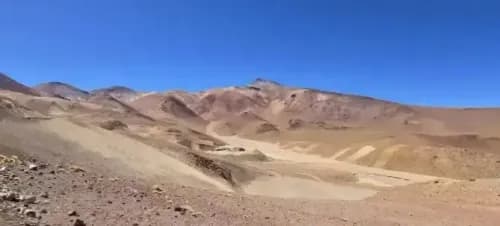
The core of this innovation lies in the San Juan Andes, specifically in the Department of Iglesia. This is where diatomite is extracted, a mineral composed of fossilized remains of microscopic algae. The international recognition of this mineral is remarkable, to the point that the San Juan variety is preferred in the world's most demanding markets over production from other countries with higher chemical purity. Although deposits in countries such as Peru and Canada contain silicon levels exceeding 90%, the San Juan diatomaceous earth, which contains between 70% and 75% silicon, is regarded as superior because of its physical properties and internal structure.
The biological effectiveness of the product does not depend on its chemical composition but rather on the so-called frustules. These microscopic structures act as tiny spines or sword-like points that mechanically affect insects. Josué Goldin explained that the quality of the local mineral allows these frustules to be more effective in injuring pests, facilitating their subsequent elimination without the need for synthetic poisons. This physical mode of action prevents insects from developing resistance, a growing problem associated with conventional agrochemicals, whose effectiveness declines over time.
Agrogol's production process is meticulous and divided into strategic stages carried out within San Juan Province. Everything begins in Iglesia, where an initial classification is performed based on topographic surveys of the deposit. Depending on whether the mineral will be used for grain protection, fertilization, or industrial applications, different sectors of the quarry are selected.
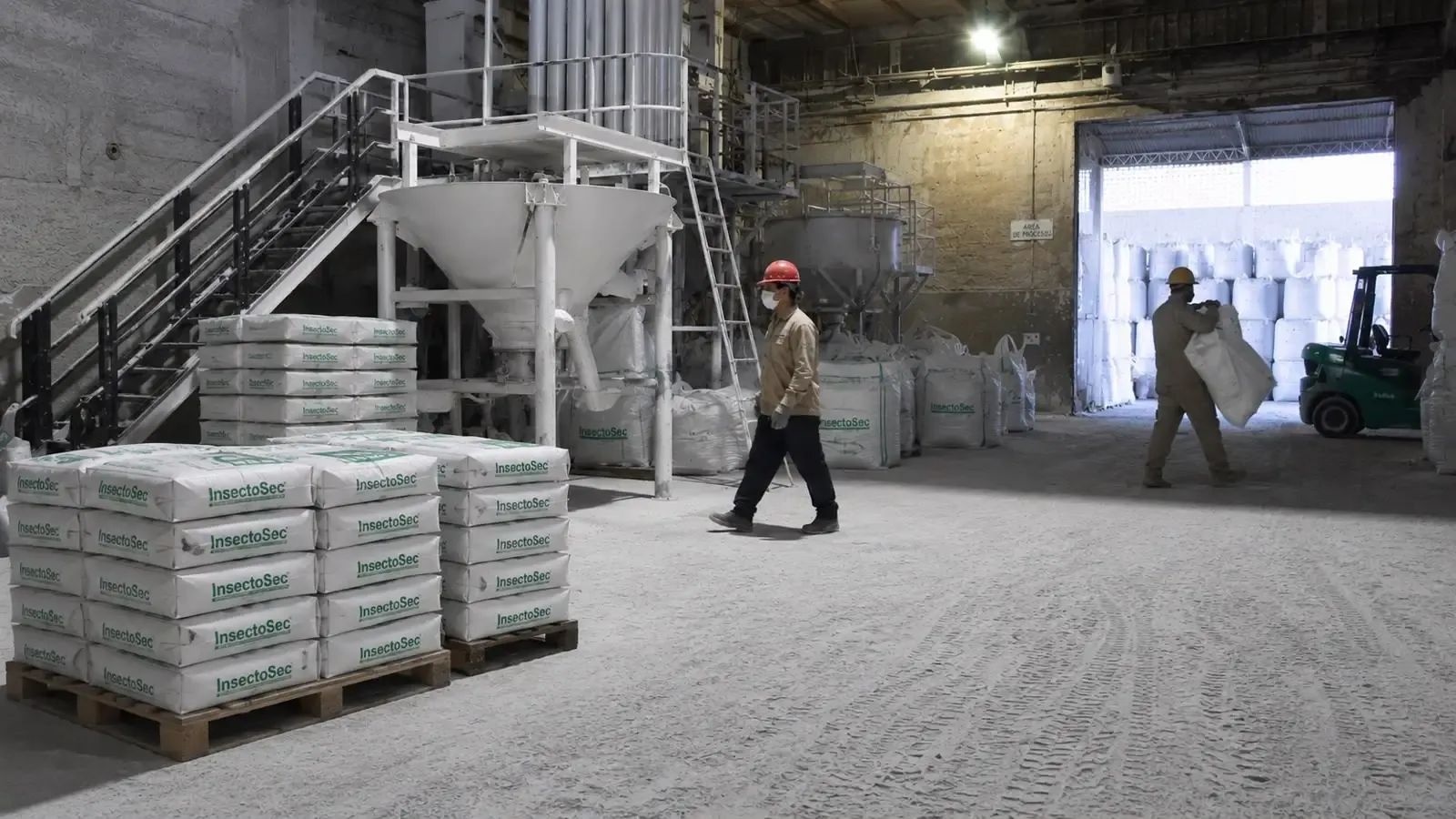
The material is then transported to the company's pilot plant in the Department of San Martín. At this processing facility, a second classification is carried out based on specific gravity. Since diatomite is an extremely lightweight mineral, this step ensures that the final product reaches a purity level of 98%, eliminating heavier sediments that may have been transported by Andean erosion.
A key differentiating factor at the San Martín plant is the mineral treatment method. Unlike conventional grinding systems that use ball mills or hammer mills—which tend to round off the mineral's frustules and reduce their effectiveness—Agrogol applies a disintegration process. This technique ensures that the greatest possible number of frustules remain sharp and pointed, maximizing the product's natural insecticidal effect.
Furthermore, throughout the six processing stages leading to bagging, the mineral undergoes static conditioning to ensure that, once applied, it immediately adheres to contact surfaces rather than remaining suspended in the air.
The development of the liquid diatomaceous earth product, marketed under the Insectosec SC brand, represents a major technical breakthrough. It is not a mineral diluted in water, but rather a stable concentrated suspension that does not settle or clog the nozzles of spraying equipment. This technology allows a mineral product to be applied with the same versatility as a liquid, using agricultural drones, aerial spraying aircraft, or ultra-low-volume application equipment. The innovation opens up a wide range of biological applications, as the product functions as a foliar fertilizer that provides thirty-nine essential micronutrients and 60% silicon, strengthening the cellular structure of plants while simultaneously controlling pests.
In terms of plant health, this development from San Juan is used in applications ranging from the post-harvest protection of grain stored in silos to the control of quarantine pests that are critical to regional economies, such as the Mediterranean fruit fly and the European grapevine moth (Lobesia botrana). As a 100% ecological product, it provides producers with a tool capable of reducing the use of hazardous agrochemicals by up to 75%, while complying with increasingly stringent international regulations that are progressively banning traditional chemical molecules.
Agrogol's outlook already extends beyond Argentina's borders. With an established commercial presence in Uruguay, the Dominican Republic, and Paraguay, the company has taken a decisive step toward international expansion by obtaining its corporate registration in Ecuador. Josué Goldin has projected that during 2026 the company will inaugurate its own branch in that country to supply the entire Caribbean region.
This expansion responds to a global crisis affecting the grain trade. Recently, major exporting companies had large shipments rejected in markets such as China due to the presence of chemical residues, demonstrating that international environmental regulations no longer tolerate the levels of toxicity accepted in the past.
Josué Goldin's vision for Agrogol is founded on a commitment to human health and the sustainability of the global food system. The company has even developed complementary technologies such as the Atmospheric Machine, a device that enables solid diatomaceous earth to be applied automatically inside silos up to 50 metres high, preventing operators from coming into contact with dust while ensuring complete grain coverage.
The integration of specialized equipment and biological products positions the San Juan-based company as one of the leading biological alternatives in the Southern Cone for the treatment of cereals and seeds.
The liquid diatomaceous earth developed in San Juan symbolizes a paradigm shift in agriculture. By harnessing the natural resources of Iglesia and the technical capabilities established in San Martín, Agrogol demonstrates that it is possible to lead international markets from Argentina's interior. Its commitment to products that do not generate resistance, require no pre-harvest interval, and protect human health is the driving force behind this green revolution, bringing the name of San Juan to the shelves of the world's most demanding markets as a synonym for quality and environmental responsibility.