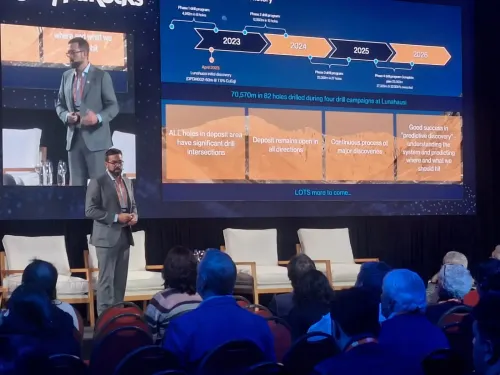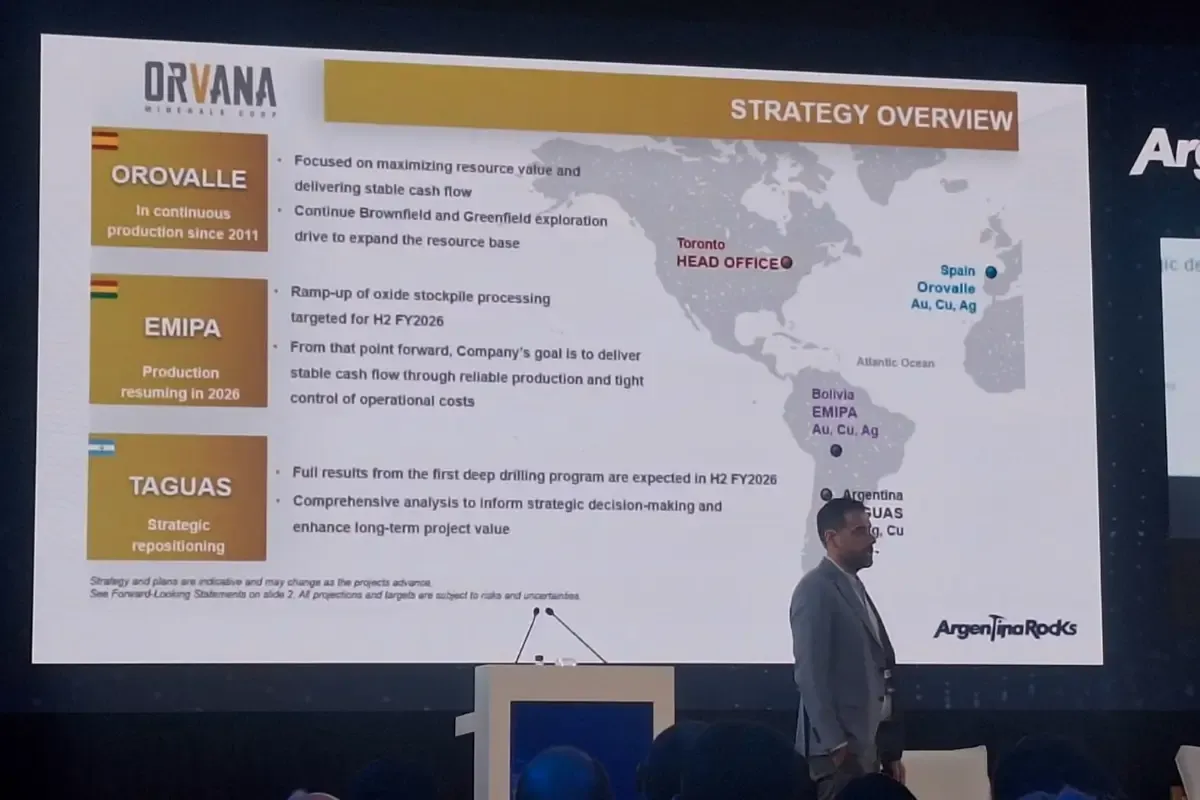
The company presented how the historic Valle del Cura project in San Juan Province has begun to be reevaluated under a model associated with deep porphyry systems.
By Panorama Minero
The presentation was led by Raúl Álvarez, Exploration Director and Technical Services Manager at Orvana Minerals, who summarized much of the project’s new exploration approach in a phrase that became the central theme of the entire presentation: “We decided to revalue all the information.”
Based on this conceptual redefinition, Orvana began reviewing decades of accumulated geological information from a project that had historically been interpreted under a high-sulfidation epithermal model, in order to evaluate the possibility of a deeper porphyry environment.
From the Epithermal Model to Deep Exploration
One of the most relevant aspects of the presentation was the change in exploration scale proposed by the company. Álvarez explained that “there had never been deep exploration at the project aimed at porphyry systems,” highlighting a clear distinction from the historical exploration campaigns carried out at Taguas.
This shift in focus was supported by a new deep geophysical survey conducted over approximately 4 km², designed to investigate targets at depths approaching 1,500 meters.
According to the company, the new work identified subsurface anomalies compatible with geological models commonly used in copper-gold porphyry exploration.
“The new geophysical campaign identified a low-resistivity anomaly coincident with increased temperature, copper, and molybdenum,” Álvarez stated during the technical presentation.
The reinterpretation also began to modify the regional geological understanding of the project. While Taguas had historically been associated primarily with oxidized epithermal gold and silver mineralization, the company started to identify evidence consistent with a deeper and higher-temperature hydrothermal system.
Orvana also showed that the new porphyry-related mineralization vectors were identified along an approximately 2.5-kilometer north-south corridor extending from Cerro IV to Cerro Campamento.
The First Deep Drill Holes
Another central aspect of the presentation involved the launch of the first deep drilling program at Taguas specifically targeting porphyry objectives.
Drill holes TADD278 and TADD279 reached depths of 1,332 and 842 meters, respectively, within the corridor where the company began identifying vectors associated with porphyry-style mineralization.
According to the technical information presented by Orvana, both holes intersected a vertically zoned hydrothermal system showing a transition from high-sulfidation epithermal conditions toward a deeper porphyry environment.
Petrographic studies conducted on drill core samples also identified a mineralized dacitic porphyry with strong silicic and sericitic alteration, accompanied by pyrite, enargite, and chalcopyrite.
“We have already been able to identify the porphyry system in the drill holes,” Álvarez stated.
The company also explained that the new drilling program identified quartz-sericite-pyrite alteration zones consistent with hydrothermal environments associated with porphyry systems.
A New Geological Interpretation for Taguas
Beyond the specific results, Orvana’s presentation delivered a broader technical message regarding part of the exploration now emerging in the Argentine Andes: the deep reinterpretation of historical projects through new geophysical tools, deep drilling, and the comprehensive reevaluation of previously collected geological information.