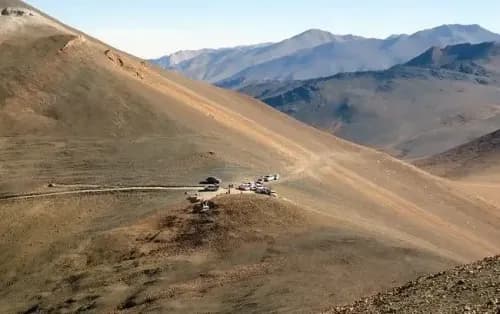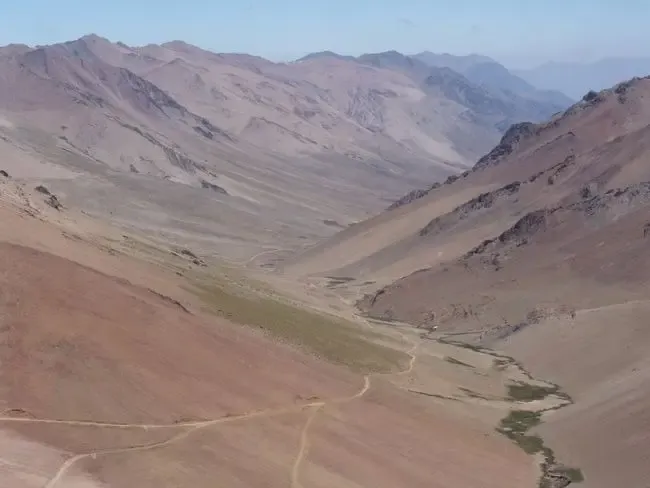
From the Mountain Roads Engineering School at the National University of San Juan, Leonardo Jaime Fullana and Marcelo Gastón Bustos argue that the current road network—originally designed for traditional social and productive transit—already shows signs of deterioration caused by heavy transport, affecting both road safety and the quality of life of local communities.
As an alternative, they propose developing an exclusive mining corridor connecting the Andean mining projects without interfering with urban traffic, while also improving provincial logistics. The initiative includes strategic works such as new road alignments, bypasses, and connections to Chile, with a long-term vision based on investment, sustainability, and regional integration.
By Panorama Minero
The province of San Juan stands at a historic turning point regarding its economic development and territorial configuration. The expansion of large-scale mining activity has revealed that the current road system—originally designed for social connectivity and traditional agricultural transport—is insufficient to meet the demands of an industry that moves extraordinary loads and requires highly precise logistics. From the Mountain Roads Engineering School (EICAM) of the National University of San Juan, authorities have presented both a comprehensive diagnosis and a technical roadmap to transform the province’s road infrastructure. Specialist engineer Leonardo Jaime Fullana, director of the institution, and Dr. Marcelo Gastón Bustos, deputy director, agree that the creation of a dedicated mining corridor is not only an operational necessity, but also a unique opportunity for the province’s structural growth.
The Mismatch of the Current Road Network and Its Impact on Communities
Historically, San Juan’s roads were designed to facilitate the transportation of people and agricultural goods between rural communities, without anticipating the heavy freight traffic required by modern mining. This lack of planning has caused progressive and visible deterioration on key transport routes. Leonardo Jaime Fullana warns that major national highways such as Route 40 are experiencing material fatigue and permanent structural damage, manifested through the proliferation of potholes, because their pavements were never engineered to withstand the mining logistics traffic they now carry.
This issue extends beyond industry and directly affects society. Since public roads are currently the only supply routes for mining operations, ordinary users face deteriorated roads, increased transportation costs, and reduced road safety. The specialists emphasize that current maintenance efforts are insufficient and warn that, without urgent intervention, future rehabilitation costs will exceed those of preventive investment. Infrastructure such as the old bridges in Calingasta has supported excessive loads for decades and now risks collapse under the passage of new heavy convoys. Therefore, detailed studies and structural assessments are required, considering these structures were designed and built more than 50 years ago.
The Proposal for an Exclusive Mining Corridor
The solution proposed by the Mountain Roads Engineering School consists of implementing a mining corridor connecting major projects located in the Andes—such as Los Azules, Pachón, and Altar—allowing heavy freight traffic to circulate independently from traditional provincial roads. The objective is for mining projects to interconnect through a common logistical axis that would later channel cargo toward specific nodes of the national transport network, avoiding mandatory transit through urban centers and reducing interference with everyday traffic.
Innovation in Design and Environmental Sustainability
According to the institution’s directors, the design of these new roads must be consistent and aligned with driver expectations. The specialists stressed that, in complex topographies, controlled design speeds allow roads to better adapt to natural terrain, reducing the need for massive earth movements, hillside cuts, or large embankments that impact the environment.
Beyond road geometry, EICAM has led research on soil stability and environmental impact reduction. Since many mining roads are dirt or gravel roads, dust emissions generated by constant traffic from trucks and light vehicles constituting a critical factor. Researchers have studied the use of chemical products and soil stabilizers which, when mixed into the road surface layer, create firm and dust-free surfaces, minimizing environmental impact in Andean valleys while improving visibility and operational safety.
Strategic Projects: The Jáchal Bypass and Route 150
One of the most technically significant areas is located in northern San Juan, along National Route 150 between Jáchal and Rodeo. The current alignment presents complex challenges, including tight-radius curves and steep slopes. Additionally, the area suffers from constant rock falls—locally known as “lagrimeos”—which require uninterrupted maintenance after every rainfall event.
In response, Engineer Fullana mentioned the existence of executive projects developed by the School proposing an alternative alignment along the lower section of the Jáchal River. This new route would feature gentler slopes of approximately 3% and would avoid the most geologically unstable zones. The proposal also includes the construction of a bypass around the city of Jáchal.
Route 153 and the Logistics Connection to Southern Argentina
Another strategic axis identified by the institution is National Route 153, connecting Los Berros with Barreal. This corridor is considered highly valuable because it would substantially reduce travel distances for freight transport heading toward southern Argentina or Chilean ports, avoiding the congested passage through the city of Mendoza.
EICAM designed an executive project for this corridor in 2012, including major engineering works such as a tunnel through the Santa Clara Gorge and several bridges to overcome geographical difficulties. Today, the road is practically impassable due to lack of maintenance and water runoff damage. According to the institution’s directors, completing this project is essential so that San Juan does not depend on neighboring jurisdictions for access to the Pacific and to provide a decisive boost to the region’s lime and mining industries.
Binational Integration and the Future of Mountain Passes
The Mountain Roads Engineering School’s vision extends beyond the border. Although the Agua Negra Tunnel project has been San Juan’s priority, engineers Bustos and Fullana argue that the province should aspire to a complementary network of mountain crossings. Despite its importance, the Agua Negra Tunnel has faced delays due to the political priorities of Chile’s central government, whose decision-making structure differs from Argentina’s federal system.
Given the recurring congestion and closures affecting crossings such as the Cristo Redentor system in Mendoza, the development of alternatives like the La Chapetona Pass—located at lower altitude and therefore operable for much of the year—has become imperative.
A State Commitment and Professional Training
Finally, EICAM authorities emphasized that implementing this infrastructure plan requires political consensus that transcends government administrations. Since these works may take decades to complete, a public-private investment framework is necessary, in which mining companies assume part of the risk while the State guarantees project continuity as a long-term policy.
The Mountain Roads Engineering School, which since 1983 has trained specialists from across Latin America, positions itself as a key technical support institution for this development. According to its authorities, San Juan must continue strongly supporting mining development in order to achieve the qualitative leap in infrastructure demanded by its future.