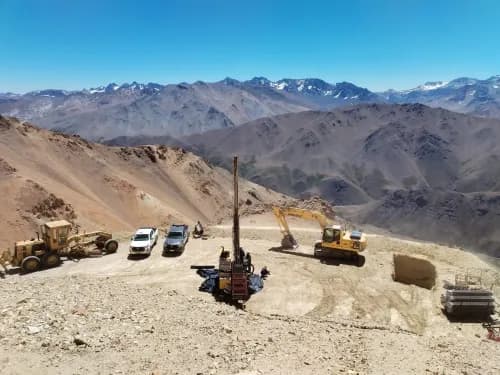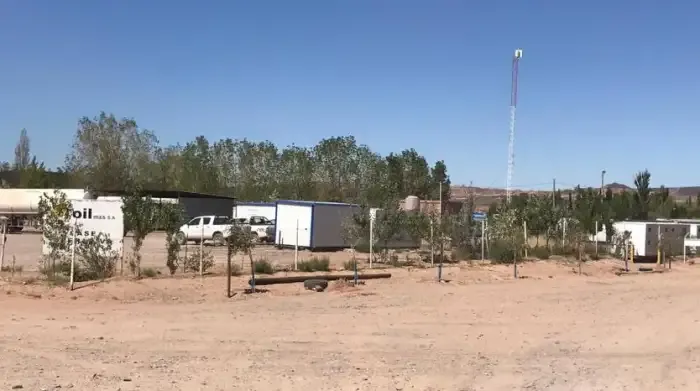
Conceived as a services and infrastructure hub, the project aims to organize and support productive development without repeating the isolated schemes of the past.
By Panorama Minero
In the far south of Mendoza, far from major urban centers and from the short-term debates that often dominate the public agenda, Pata Mora seeks to consolidate itself as one of the most significant structural initiatives to reshape the productive matrix of this Andean province. It is neither a deposit nor an extractive project in itself, but rather something that, from a mining perspective, is just as—if not more—decisive: infrastructure, logistics, and services designed to sustain large-scale industrial production.
Located in the southern part of the Malargüe department, near the border with Neuquén, Pata Mora was conceived as a logistics, industrial, and services hub aimed at addressing a historic shortcoming in southern Mendoza: the lack of a node capable of supporting mining, energy, and oil projects without relying on external logistics centers, which entail higher costs and lower operational efficiency.
From concept to territory: legal framework, land, and planning
Pata Mora’s development has not been rapid, but it has been steady. After years of planning, the Province managed to move forward on three key milestones: the consolidation of the legal framework, the taking possession of the site—approximately 3,500 hectares—and the drafting of an urban and functional master plan that organizes industrial uses, access routes, service areas, and environmental buffer zones.
This work made it possible to move beyond the conceptual stage and advance toward a decisive phase for any development of this scale: detailed engineering. In July 2025, the Government of Mendoza launched an international tender for the preparation of the hub’s executive projects, a technical step that is essential to define costs, construction sequencing, and technical conditions for road access, power supply, basic services, and minimum urban development.
Without executive projects, no construction is possible; with them, the park is in a position to enter a gradual construction phase, aligned with the arrival of productive demand.
Mining as a core axis, but not an isolated activity
Mining occupies a central place in Pata Mora’s logic, though not as an extractive enclave, but as part of a value chain that requires permanent logistical support. The precedent of the Potasio Río Colorado project, the copper potential of southern Mendoza, and proximity to areas linked to Vaca Muerta reinforce the idea of a hub capable of providing technical services, transportation, storage, industrial maintenance, and specialized supplies for large-scale operations.
From a mining standpoint, the premise is clear: without adequate roads, reliable energy, industrial land, and services, no project can be sustained over time. Pata Mora seeks to resolve this structural bottleneck by anticipating demand and avoiding the need for each venture to build its own logistics from scratch.
Conceived as a long-term state policy, Pata Mora stems from a planning process that began in 2018 and involved more than five years of technical studies and legislative decisions.
The enclave was designed as an industrial, mining, and oil hub capable of reversing the historic logistical dependence of southern Mendoza on Neuquén. On this basis, a plan was developed that organizes industrial, urban, and productive uses; incorporates buffer zones, energy infrastructure, effluent treatment, and new access routes; and defines a legal and commercial model for its operation.
In investment terms, the overall scheme of works linked to the park—including National Route 40, Provincial Route 189, and the Cortaderal–PRC–Pata Mora power line—was estimated at around US$300 million, while the package of priority works under provincial jurisdiction is close to US$200 million.
The executive project stage alone requires nearly US$6 million, channeled through the Trust for the Development of Malargüe and the Pata Mora Logistics and Services Hub. This entity was empowered to manage the park, execute infrastructure works, and coordinate the arrival of private investment, with the explicit goal of strengthening mining, energy, and services with strong territorial anchoring in Mendoza.
A long-term bet to change the development logic
Pata Mora is not presented as an immediate solution or a short-term announcement. Rather, it is a strategic, long-term initiative designed to move Mendoza away from debating each mining project as an isolated case and toward building stable territorial conditions for industrial production.
If the hub manages to make the leap from engineering to construction, southern Mendoza could, for the first time, have its own logistics hub capable of supporting mining, energy, and industry with local infrastructure, specialized services, and a systemic vision of development. In this sense, Pata Mora does not define Mendoza’s mining future on its own, but it could become the platform that allows that future to move beyond mere geological potential.
Timeline of Pata Mora’s development
-
2019–2020
The Province of Mendoza begins evaluating the need for a logistics and industrial hub in the far south of the province, linked to mining, energy, and large-scale activities. -
2021
Progress is made in defining the project institutionally, identifying the Pata Mora area as a strategic asset and establishing the initial boundaries of the site. -
2022
The provincial government takes possession of the land—approximately 3,500 hectares—and begins the legal and land tenure organization of the area. -
2023
The urban and functional master plan is developed, defining land uses, industrial areas, access routes, buffer zones, and environmental criteria for the hub. -
2024
A specific trust is established to finance technical studies, planning, and initial interventions, and Pata Mora is prioritized within the southern Mendoza infrastructure agenda. -
July 2025
Mendoza launches an international tender for the preparation of the executive projects, a key step in defining detailed engineering, costs, and construction sequencing. -
2026
With the executive projects completed, Pata Mora is ready to begin basic infrastructure works (access roads, energy, and services) and to start operating as a logistics support hub for mining, energy, and industry.